

what doesn't kill you, breaks you.
inside the shoebox: a childhood. a reckoning. a conversation between two good friends.

content warning. pseudonyms are used to protect privacy.
The gravedigger of families, the murderer of memories. In the heart of the carnage, my mother’s hand is still in mine. This carnage, here it is.
- Caroline Darian, author of I’ll Never Call Him Dad Again (2025).
Let’s say you’ve been working in a construction company for two decades. Despite the gruelling hours and thankless overtime, you pour your heart into your work every single day through faith.

Faith powers you.
Faith that they’ll see you.
That they’ll reward your loyalty.

But reality is a cruel mistress. The company is going under. They’re withholding your paycheques. Still, they demand long hours and offer only apathy in return.

Finally, one day, you snap.
You get up, drop your hardhat, and walk away.
You start your own thriving company, as your ex-employer’s empire implodes without your support.

People say, Good for you! You dodged a bullet.

But did you?
You still gave two decades of your life. You still bore the weight.
And it hurt.
Your body, broken by labour; your mind, beaten by brutality.

So, no. You didn’t dodge a bullet.
 It went right through.
And you scarred from it.
I was keeping my friend, Raven, company on her couch while she cleaned. In her tidying frenzy, she unearthed a weathered shoebox, held together by a yellowed rubber band.

“Ugh, of course I would do this to myself,” she muttered. “More shit to rummage through.”

She peeled the rubber band away and opened the lid. “I think this is stuff from when I was a kid. What did I even put in here?”

She joined me on the couch and peered into the keepsake with trepidation.

“My whole childhood was a punishment. I’m not sure I want to open that Pandora’s box.”
Raven has always had a complicated relationship with her family. An elliptical household branched from an emotionally dichotomous family tree; her father’s side were bristling, bitter people; her mother’s side, warm and welcoming.

Looking back, it made sense: her father’s pathological cheating, questionable fetishes, and raging porn addiction. The signs were all there, just cloaked by his church-going, family-man facade. But it would be Raven, just six years old, who becomes the catalyst for the family’s collapse when she exposes her father’s affair to her mother.

From that day forward, she was both child and adult.
The caretaker. Dressing her sister for school.
The chef. Feeding the family between fights.
The emotional sponge. Absorbing every grown-up grief.

Somehow, through it all–school, church, dinner–she would host demons in silence.
We lingered over a photo of her at six with her toddler cousin. Raven picked it up with a rueful smile.

“I think this is a very good example of what my childhood looked like,” she said.

“How so?”

She traced the outlines in the photo and landed on her arm wrapped around her cousin. The others were grinning, but she wore a half-smile out of instinct.

The glint of alertness in her eye was unmistakable.

“The only thing I was focused on was the threat in the room,” she murmured, teeth clenched. “Shit had already started going down by then.”
Like clockwork, every Tuesday, her father would wait patiently for the house alarm to beep twice: that's the signal that her mother and sister were gone for swim practice.

Then, he’d drag Raven into the kitchen.
Sit her on a stool.
And scream.

He would scream at his own flesh and blood, wishing away her existence and threatening to make it happen himself.
He would seethe with visceral venom, curse her for her honesty.
He would shove the weight of his crumbling marriage into her terrified arms.

She would sit still, numb, focused only on the tomato-red shade of his neck and the spit that would land on her cheek.

Even the strongest of minds would crack under such lethal Pavlovian-esque techniques. Raven reached for two more photos. Her expression softened as she gazed at the grey-haired figures smiling in the muted colours. “You can also tell when I felt safe.” My eyes were immediately drawn to an elderly woman with silver wire glasses. My friend’s eight-year-old arms were thrown around her neck, her lips pressed against the lady’s cheek. Strawberry blonde bob blending into soft grey curls. In another, my friend sported a neon pink hoodie and a content look, resting in the arms of the same beaming woman. Raven’s smiles were soft. Real. “Is that grandma?” “Yes. Nana, from my mother’s side,” she said with a familiar warmth. “She was my real mother, God rest her soul.” She pulled out another photo. Same bob, same hoodie, but this time she was curled up on an older man’s lap. Her lips were sealed. Her eyes were wide. “I loved Papa too, but his crowd was more… unsavoury,” she trailed off, chasing the thought.
Raven dropped her grandfather’s keyring on the cracked linoleum flooring as the front door slammed open. She scrambled back onto her grandfather’s lap, pressing herself against his checkered button-up as men clambered into the dining room. She locked eyes with one man, who bared his teeth in a poor attempt of a smile.

“Teddy, you got company!” He crouched beside her. He wrapped his hand around her knee and gave it a jiggle. “Have you been a good girl, Raven?”

She could barely breathe through the stench of old Screech Rum on his stained denim jacket. She avoided his gaze and studied the fissures that split the linoleum (like everything else held together for far too long). She held her breath as his hand slid up to her thigh and squeezed, his dirty fingernails digging into her flesh.

“She’s quiet. I like quiet girls.”

Before she could respond, she felt his grip slide away and both of her feet on the tiles. “She’s quiet, but she’s got a good head on her shoulders. She’ll have plenty to share with the world when she’s ready.”

A nudge on her back sent her running.
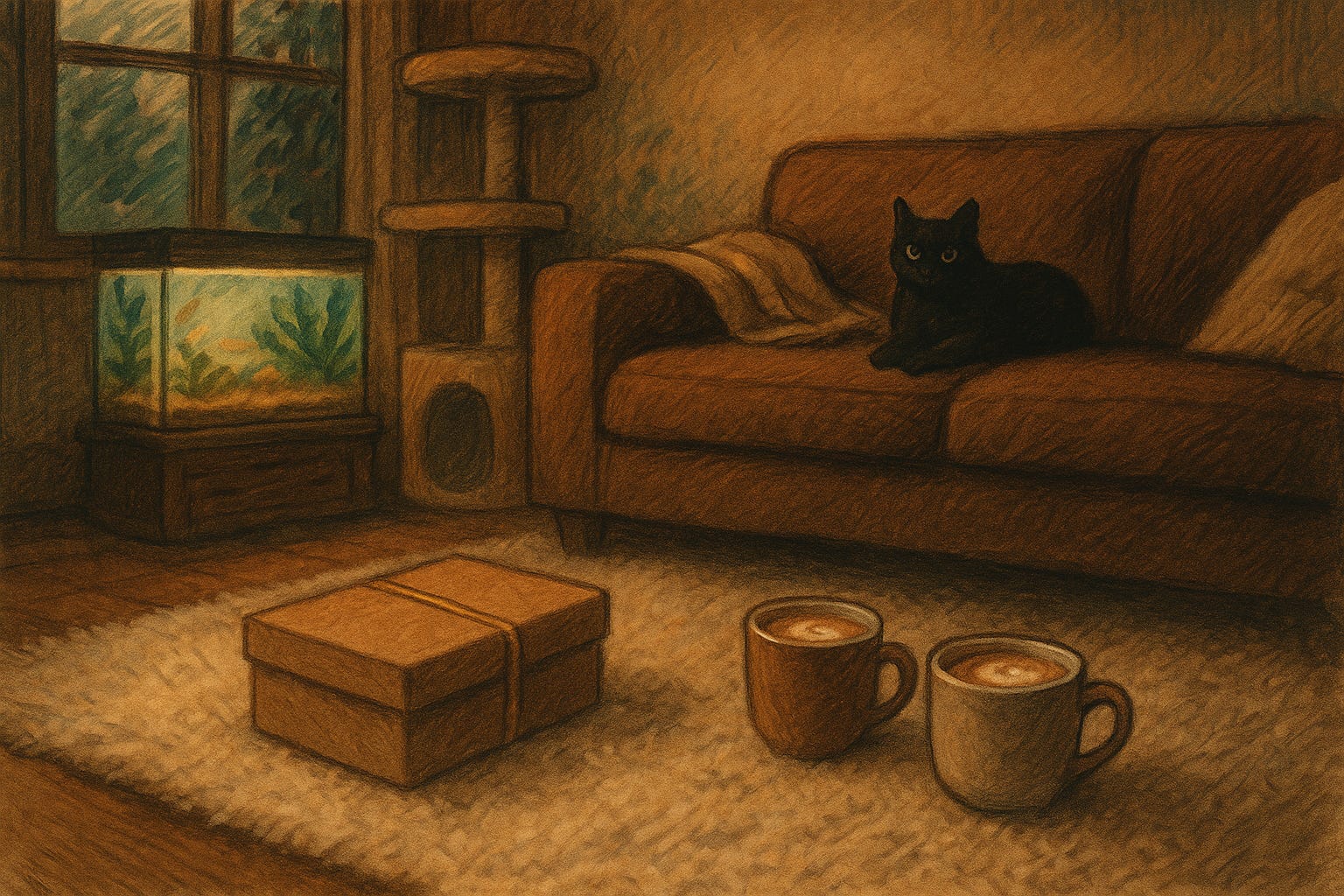
Her grandfather had given her freedom. Raven dropped the photos back in the box. Picking up the cardboard lid off the floor, I handed it to her. She took it and held it tightly. “It’s pretty crazy to think back on it,” she murmured. “By age seven, I was praying my dad would kill me. By eight, I had an eating disorder. By eleven, I was self-harming. I had no Internet and no idea what I was doing or what it all meant.” She gestured around her apartment. Sunlight filtered through the greenery. Twinkling crystals glittered in the windows. Pet toys littered the rug. A cozy cat tree resided in a soft-lit corner by glowing fish tanks. In a little nook, two workspaces were lit with decor and love. “10-year-old me would be over the moon,” she said softly, words folded in thought. “Our own apartment with big windows. A dog, cat, and fish. Purple hair and tattoos and smoking weed. A partner who actually loves us.” She chuckled. “She’d think I was the coolest person ever.” She gave the box one last glance, then shrouded the photos in shadow. I grinned. “What doesn’t kill us makes us stronger, eh?” She shook her head. “No.” She slid the rubber band back around the box like a hushed prayer. She took my hands in her own.
it may not have killed me, but it broke me.
and i heal; not because of it, but in spite of it.
triumph doesn’t have to be loud.
it must be your truth.
healing is still a kind of rebellion.
remembering is its own form of power.

some of my most cherished moments are the quiet conversations with my loved ones: their past, their stories, their trust.
it allows me the privilege of learning,
the honour of sharing,
and the promise of carrying them forward.

thank you for being here.
you are not alone in the remembering,
or the healing that comes after.
If something stirred in you and you'd like to leave something behind,
a coffee ☕ is always welcome.
It keeps the conversation warm and the table set for next time.🌿 As always, thank you for stopping by to read my weekend musing. I hope you’ll stay for a cup of coffee. ☕
Great read. Love this counter idea to what doesn't kill me makes me stronger. So true.
"But reality is a cruel mistress" ahhh😭🫶